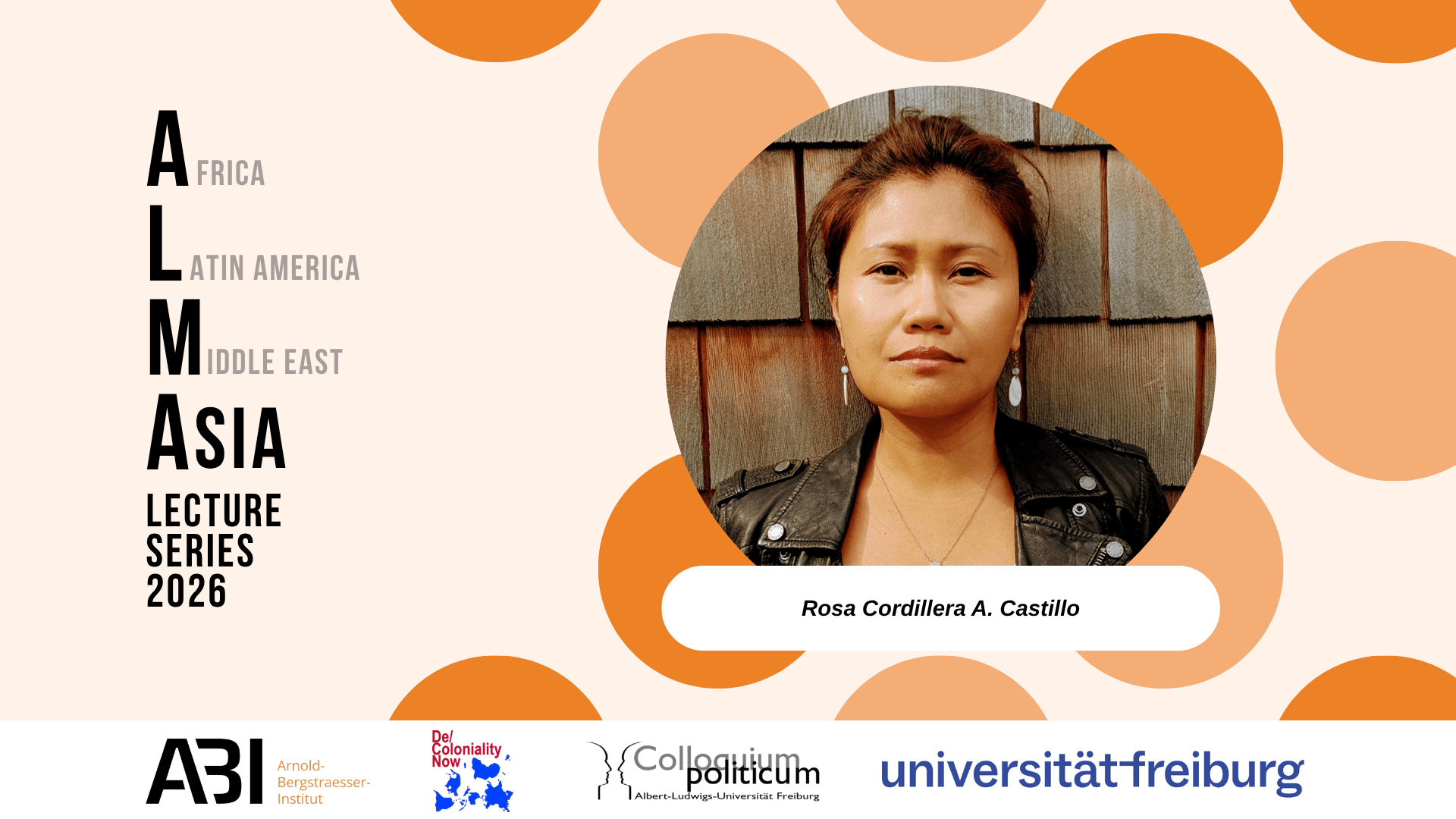
Rosa Cordillera A. Castillo is a public anthropologist and curator whose work explores peace and (post)conflict dynamics, struggles for self-determination, and practices of resistance and solidarity through decolonial and ethically engaged approaches. She has published extensively on these topics, including co-editing the book Thinking with the South: Reframing Research Collaboration Amid Decolonial Imperatives and Challenges (2023, DeGruyter) and the double special issue Negotiating Research Ethics in Volatile Contexts (2022 and 2023, International Quarterly for Asian Studies). She has held temporary professorship positions at Freie Universität Berlin, the University of Bremen, Humboldt-Universität zu Berlin where she established the Philippine Studies Program, and the University of the Philippines. Rosa is currently a Research Fellow at the Institute for Health and Social Sciences at the University of South Africa.
Abstract:
Within transitional justice, the relationship between environmental and more-than-human concerns and (post)conflict dynamics has been largely overlooked in processes of reconciliation, reparation, and justice. Dominant frameworks, which focus mainly on human rights to address historical injustice and harms, have tended to separate human concerns from those of the environment and more-than-human world.
The emerging field of ecocentric transitional justice, informed by non-Eurocentric legal frameworks as well as indigenous epistemologies and ontologies, challenges this divide by emphasizing the interdependence and non-hierarchical entanglement of the human and more-than-human worlds. It positions both as essential to sustainable peacebuilding.
In this talk, Rosa Cordillera A. Castillo draws upon the ecocentric approach, together with the anthropology of transitional justice, to shed light on the environment-(post)conflict-transitional justice nexus in the Bangsamoro Autonomous Region in Muslim Mindanao. Recently emerging from six decades of conflict, the region is pioneering the Philippines’ first transitional justice process involving Muslims, Non-Moro Indigenous Peoples, Christian settlers, and the Philippine government.
Against this backdrop, Rosa Cordillera A. Castillo inquires into the multiple conceptualizations and practices of truth, truth-telling, justice, and repair among historically antagonistic groups in the region, and examines how environmental and more-than-human harms and concerns are raised and addressed in the BARMM transitional justice process and (post)conflict and environment and economic development plans. Finally, Rosa Cordillera A. Castillo reflects on the possibilities and limits of existing legal instruments and the ecocentric approach for reimagining reparations that encompass conflict’s full spectrum of harms.
This lecture is part of the 2026 ALMA Lecture Series titled 'Global Ruptures or New Beginnings? Southern Perspectives on World Politics'. The ALMA (Africa, Latin America, Middle East and Asia) Lecture series is a series organised by the Arnold Bergstraesser Institute at the University of Freiburg in cooperation with the Colloquium Politicum addressing theoretical, empirical and methodological questions from a Global South perspective. This year’s lecture series is co-organised with the De/Coloniality Now Initiative of the University of Freiburg. This multidisciplinary initiative seeks to understand the impact of coloniality on today’s world and the ways in which people and institutions in all regions of the world, including our own, remember, perpetuate, and contest the legacy of colonialism with a focus on the present day (“now”).